

By using this site, you agree to the Privacy Policy and Terms of Use.
Accept
NewsunplugNewsunplugNewsunplug
  • Home
  • News
  • Politics
  • Metro
  • Entertainment
  • Sports
  • Lifestyle
  • My Story
Reading: ‘True tomb’ of Jesus Christ found after 2,000 years and it matches the Biblical description
Share
Notification Show More
Font ResizerAa
Font ResizerAa
NewsunplugNewsunplug
  • Home
  • News
  • Politics
  • Metro
  • Entertainment
  • Sports
  • Lifestyle
  • My Story
Search
  • Home
  • News
  • Politics
  • Metro
  • Entertainment
  • Sports
  • Lifestyle
  • My Story
Have an existing account? Sign In
Follow US
Newsunplug > Blog > Metro > ‘True tomb’ of Jesus Christ found after 2,000 years and it matches the Biblical description
Metro

‘True tomb’ of Jesus Christ found after 2,000 years and it matches the Biblical description

Godson
Last updated: August 28, 2026 11:08 am
Godson
Published: August 28, 2026
Share
SHARE

After years of searching, Italian archaeologists have discovered an ancient site that matches a Bible description of the tomb where Jesus Christ was buried.

This was made known by a preliminary study in the Jerusalem archaeological journal Liber Annuus.

“We have found evidence of a funerary landscape,” lead archaeologist Francesca Romana Stasolla, of the “La Sapienza” University of Rome, told the Daily Mail.

The researchers had been excavating Jerusalem’s Church of the Holy Sepulchre, a fourth century Roman Church that was built over a holy site where many Christians believe Christ was crucified, buried and then resurrected.

?True tomb? of Jesus Christ found after 2,000 years and it matches the Biblical description

The church of the Holy Sepulchre

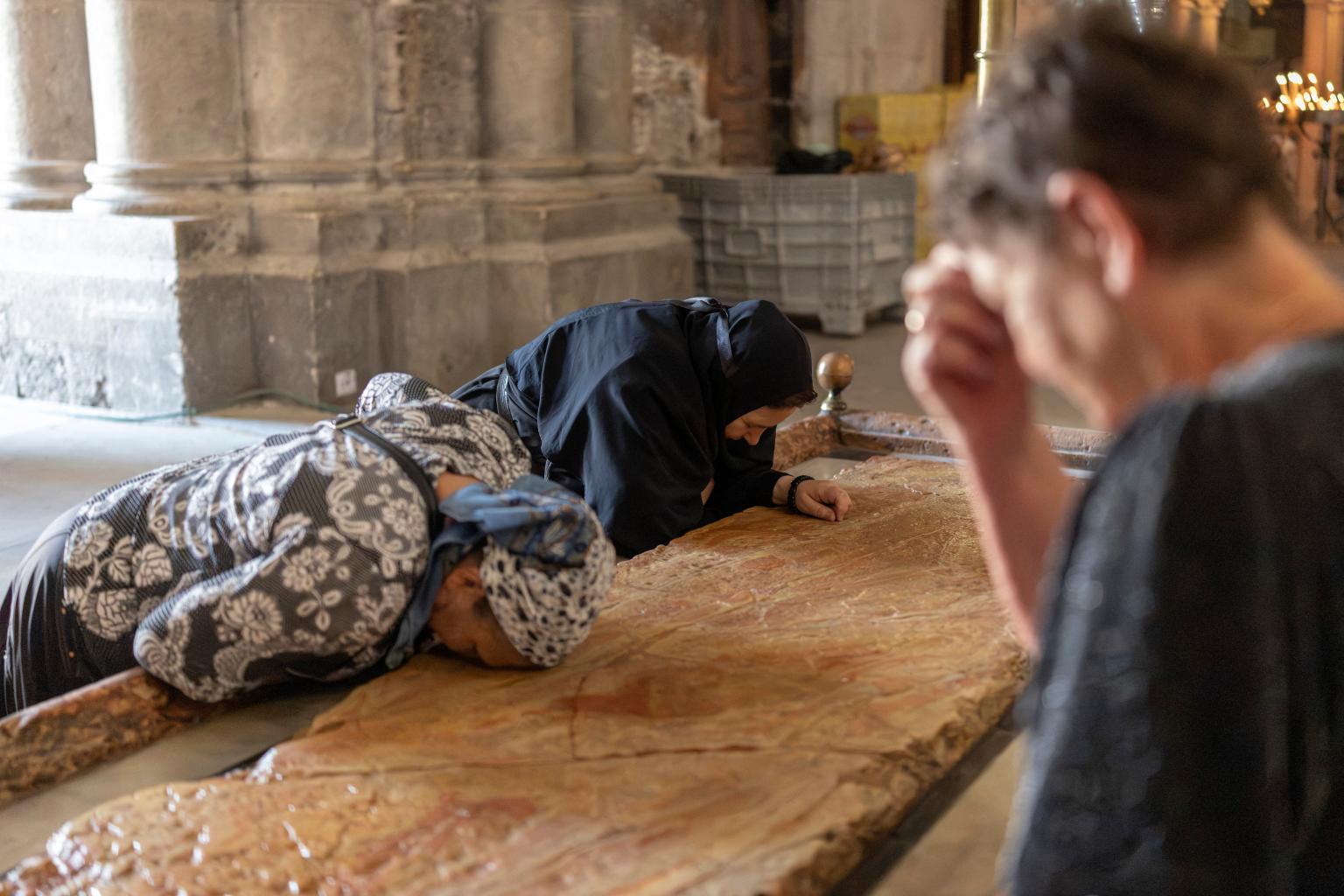
As a result, it’s become a mecca for religious pilgrims from across the world, attracting around four million visitors per year.

?True tomb? of Jesus Christ found after 2,000 years and it matches the Biblical description

Pilgrims praying at the Church of the Holy Sepulchre

During the final phases of the excavations in 2025, the team found a peculiar landscape that suggests they might have been onto something.

Underneath the church was an abandoned quarry, cultivated plots of land, rock-cut tombs and an ancient garden.

Coincidentally, the Book of John said: “At the place where Jesus was crucified, there was a garden, and in the garden a new tomb, in which no one had ever been laid.”

While no one had been found in the tomb, the abundance of parallels was compelling.

John 19:20 says that the crucifixion occurred close to Jerusalem, while Hebrews 13:12 claims that it occurred outside the city gate, which was the exact location of the quarry at the time of Christ.

Sections of the quarry measured 20 feet deep and had been filled with dirt, suggesting that it served a pastoral purpose.

The site’s agricultural function was further supported by the discovery of olive trees and grapevines — possibly the same plant referenced in John 19:41 — that date back to the time of Jesus‘ de@th, which is believed to have happened around 33 A.D.

“The gospel mentions a green area between the Calvary and the tomb, and we identified these cultivated fields,” Stasolla told the Times of Israel.

In fact, the graves, which were carved directly into the stone, proved that it was an actual burial ground, and matched descriptions by Matthew, Mark and Luke of Jesus’ grave as having been carved from rock.

The evidence goes beyond parallels to the Bible. One particular chamber had been obstructed by a Roman structure built during Emperor Hadrian’s reign in the second century.

Around 200 years later, builders employed by Constantine’s workers destroyed the Roman structure and dug up the site to reveal the tomb, which they then separated from the other chambers.

While this doesn’t definitely prove that this was Jesus’ burial site, the campaign to preserve it suggested that knowledge of the site had been passed down to early generations of Christian worshippers.

“The real treasure we are revealing is the history of the people who made this site what it is by expressing their faith here,” Stasolla told the Times. “Whether someone believes or not in the historicity of the Holy Sepulchre, the fact that generations of people did is objective. The history of this place is the history of Jerusalem, and at least from a certain moment, it is the history of the worship of Jesus Christ.”

Former Ekiti state gov, Ayo Fayose and Arise TV’s Rufai Oseni, clash on Live TV (video)
British grandmother who went to Ghana to try get her £1m savings back from scammers k!lled in car crash
NSCDC arrests teacher in Niger over alleged molestation of pupils
Man dies after being separated from his family when he was deported from UK, family blames home office
Autopsies in Kenya cult deaths confirm starvation

Quick Link

  • My Bookmark
  • Interests
  • Contact Us
  • Blog Index
Share This Article
Facebook Email Print
What do you think?
Love0
Sad0
Happy0
Sleepy0
Angry0
Dead0
Wink0

Recent Posts

  • Transfer: Nwakali Departs League One Club Barnsley
  • Dr Emmanuel Ikpeme named Interim NFF General Secretary
  • NSC Suspends NFF Elective Congress
  • EFCC To Continue NFF Probe Despite Gusau, Board Members’ Resignations
  • Musician, Augustine Miles Kelechi, popularly known as Tekno, has sparked debate after claiming that the late music icon Fela Anikulapo-Kuti was not the sole originator of Afrobeats. “Fela is not the originator of Afrobeats,” Tekno stated during an interview on Hot 97 FM in New York. “Lagos people and the Yorubas might say he is the one, but I am from the East, and we had legends like Oliver De Coque. Oliver De Coque made pure highlife music. Highlife is also Afrobeats.” Tekno argued that Fela received primary credit largely because of his global reach. “Fela gets all the credit because he travelled and performed with his band around the world. To some people, he is the originator of Afrobeats, but to me, there are a bunch of them—legends that no one speaks about.” While acknowledging Fela’s influence and citing him as the inspiration behind his hit single Rara, Tekno emphasized his own musical roots. “I would say I was more inspired by Oliver De Coque and his peers from the East. My dad used to play his music a lot.”

Recent Comments

No comments to show.

Categories

  • ES Money
  • U.K News
  • The Escapist
  • Insider
  • Science
  • Technology
  • LifeStyle
  • Marketing

About US

We influence 20 million users and is the number one business and technology news network on the planet.
Quick Link
  • My Bookmark
  • Interests
  • Contact Us
  • Blog Index
Top Categories
  • My Bookmark
  • Interests
  • Contact Us
  • Blog Index

Subscribe US

Subscribe to our newsletter to get our newest articles instantly!

[mc4wp_form]

Top Categories

  • Entertainment

Categories

  • ES Money
  • U.K News
  • The Escapist
  • Insider
  • Science
  • Technology
  • LifeStyle
  • Marketing

About US

We influence 20 million users and is the number one business and technology news network on the planet.
Quick Link
  • My Bookmark
  • Interests
  • Contact Us
  • Blog Index
Top Categories
  • My Bookmark
  • Interests
  • Contact Us
  • Blog Index

Subscribe US

Subscribe to our newsletter to get our newest articles instantly!

[mc4wp_form]
© 2023 Newsunplug | All Rights Reserved.
Welcome Back!

Sign in to your account

Username or Email Address
Password

Lost your password?