

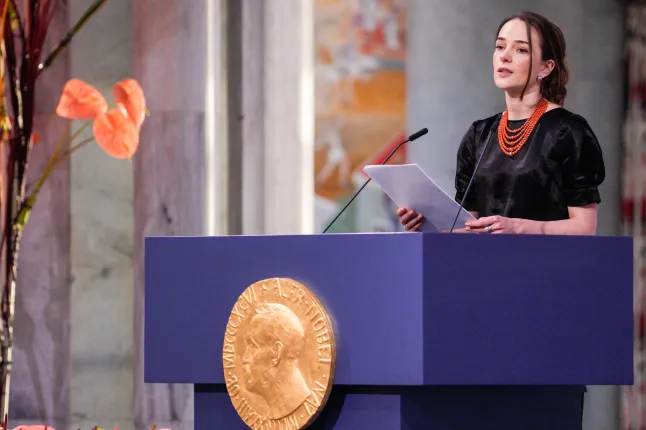

Ukrainian human rights lawyer Oleksandra Matviichuk has called for urgent international action following a report alleging that Russian medical personnel participated in the torture of Ukrainian civilians and prisoners of war. Matviichuk heads the Center for Civil Liberties, which shared the 2022 Nobel Peace Prize with Russian human rights organisation Memorial and Belarusian campaigner Ales Bialiatski.
The report, titled Anatomy of Torture, alleges that medical personnel denied essential treatment, used tasers against detainees and inflicted pro-Russian inscriptions on a prisoner’s skin. “We want to share this information to put pressure on Russia in order to save lives, because people are dying. People are dying,” Matviichuk told Metro.
“Their conditions are inhuman and the treatment is beyond human imagination.” She described the testimony of a former detainee who said he encountered medical personnel only once during his imprisonment, after losing consciousness while being tortured. “The Russian medics were invited to give an injection and to return him to consciousness, to provide the opportunity to continue the torture process,” she said. Matviichuk also cited a Ukrainian soldier who reportedly awoke after surgery to discover that the words “Glory to Russia” had been carved into his skin with a surgical instrument.
“Now this person, after returning to Ukraine as a result of prisoner exchange, is going through the process of removing this slogan from his body,” she said. “It’s a very painful and long-lasting process.” She argued that the alleged abuses were systemic, pointing to testimonies gathered over 12 years since Russia’s invasion of Crimea in 2014.
“We interviewed people who returned from the prisons, but we also interviewed people who get information from people who are close to them – their relatives, their families, who are still under occupation,” she said. “We analyse open data with other verifications, draw a lot of information about different signs of captivity in video, in social networks. And Russians are very brutal. They are not even hiding their crimes.”
The report was written by four experts at the Center for Civil Liberties with support from the UK Government. Several testimonies described a medical worker in Russia’s Republic of Mordovia whom detainees called “Doctor Evil”. One former prisoner alleged that the doctor struck detainees before asking about their symptoms.
“Your eyes are closed, your head is tilted down, and you can’t see anything. You give him your hand, and he hits you in the hand with a taser. First, he hits you with a taser, and then he gives you a pill,” the person said. Another witness alleged that the doctor participated in torture and “ensured the person stayed alive”. Ukrainian human rights group KHPG identified the individual as Ilya Sorokin. According to the report, the Security Service of Ukraine charged him in absentia in December 2025.
Matviichuk said there was “no possibility to physically arrest him because he is in Russia”. She said several submissions had been sent to the International Criminal Court in The Hague and urged it to “open the case based on these crimes against humanity”. “What must be done is provide the full access of International Committee of Red Cross to all illegally detained civilians and prisoners of the war, and to create a special medics commission to be sent to Russia to work to get access to people,” she said.
Matviichuk also called on medical professionals internationally to challenge the alleged practices, arguing that professional pressure could have a “chilling effect” because some exchanges and cooperation with Russia continued.The Center for Civil Liberties and other organisations last week issued an appeal to the World Health Organisation seeking intervention.
The letter said the WHO had “unique expertise and international capacity to draw attention to violations of the right to health, uphold international standards of medical care, and help ensure that the principles of healthcare and medical ethics remain in force even in situations of armed conflict”. The WHO declined to comment when contacted by Metro.