

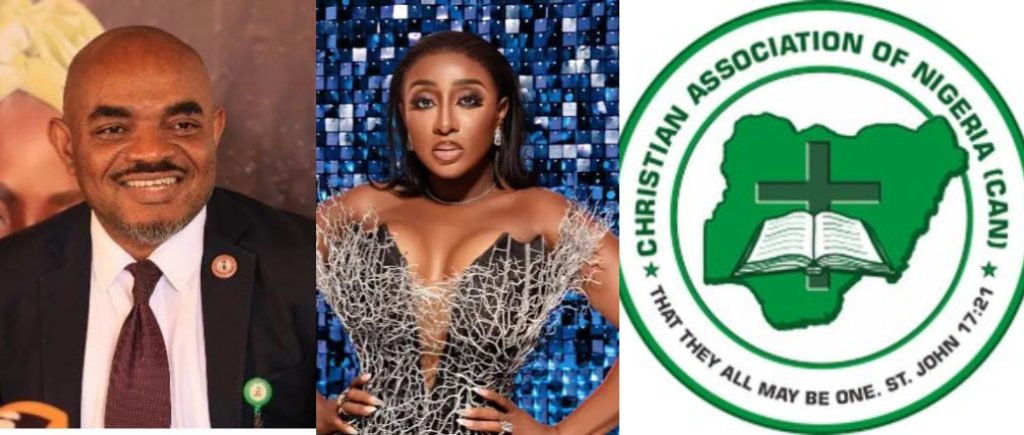

The Actors Guild of Nigeria (AGN) has come to the defence of actress and filmmaker Ini Edo following criticism from the Christian Association of Nigeria (CAN) regarding her film, Dirty Christmas.
CAN, led by its president, Archbishop Daniel Okoh, had earlier described the movie’s title as offensive to Christian values, arguing that it did not appropriately reflect the sacred nature of Christmas.
The remarks sparked widespread discussion, touching on religion, creative expression, and the entertainment industry’s boundaries.
Shaibu Husseini, Director-General of the National Film and Video Censor Board (NFVCB), confirmed that Dirty Christmas had adhered to all legal and regulatory requirements before its title was approved. However, he also encouraged Ini Edo to consider modifying the title to address the concerns raised by CAN.
Responding, Ini Edo appealed to the board not to withdraw the film, expressing her openness to making adjustments if necessary. This initially helped ease tensions until the AGN issued an official statement.
Signed by its National President, Ejezie Rollas, the guild described the film as a metaphorical and artistic work. It called on CAN to evaluate the movie based on its full content rather than judging it solely by its title.
The statement highlighted that Ini Edo is a practising Christian who values her faith deeply. It stressed that her intent was not to disrespect Christianity but to depict real-life experiences that often occur during the holiday season.
Part of the AGN’s statement read:
“It would have been more constructive to assess the film through a complete review of its content rather than focusing only on the title.”
The guild noted that the title does not insult Christianity but instead reflects the complex realities sometimes associated with Christmas, without mocking beliefs or doctrines. AGN also pointed out that interpretations of Christmas can differ among Christian denominations, emphasizing that experiences of the holiday are not uniform.
In addition, the guild defended the NFVCB, highlighting that the board operates within a legal framework designed to balance moral sensitivity with creative freedom.
The statement concluded:
“A full viewing of the film confirms that it contains no scenes or narratives that ridicule, demean, or undermine Christianity.”