

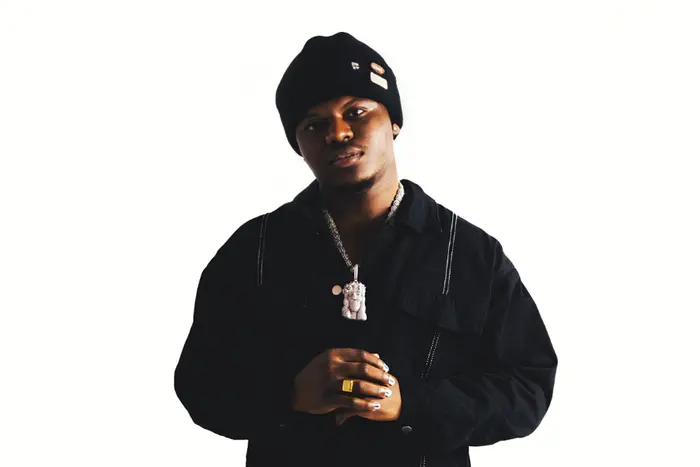

As an artist, Gbejuloban goes by several other names, including Oluwanifemi, Oladunjoye, and, within his family, Okanlawon; music was never really the plan. It became one out of necessity, curiosity, and a childhood spent hustling to survive.
Born and raised in the Jinadu area off Olateju Street, Mushin, Lagos, Oyeniyi “Gbejuloban” is the only son and last-born in a family of four children, with three elder sisters. His upbringing, he says, was shaped as much by absence as by resilience. His father was largely absent from the household due to personal circumstances; Oyeniyi “Gbejuloban” says he only came to understand later in life, leaving his mother to raise the children largely on her own.
Family history compounded the difficulty. According to Oyeniyi, his maternal grandfather, a wealthy man referred to in their neighbourhood as “Alhaji,” who reportedly had multiple wives, one of whom was his grandmother, left behind a substantial estate(properties) after his death.
However, what followed, he says, was a bitter inheritance dispute that fractured the extended family and left his mother, and by extension his own upbringing, worse off financially. Oyeniyi ”Gbejuloban” has few memories of his grandmother, who died when he was around two years old, and none of his grandfather.
Despite the instability, Oyeniyi describes himself as having been an independent, driven child who resisted the pull of his environment. By age six to eight, he was already working, running errands and using the proceeds to raise and sell chickens, a small enterprise he built with a little assistance from a childhood friend. The initiative caught the attention of his family and community, who encouraged him toward a trade.
He began an apprenticeship in carpentry while still in Junior Secondary School 1, around age 10 to 12, at Eko Boys High School in Mushin. He later completed his secondary education at Great King’s Academy in Egbeda, Lagos, after circumstances prevented him from finishing at his original school.
Early Encounter With Music
Long before he considered a career in music, Oyeniyi was immersed in it. He served as a pianist and keyboardist in his church and picked up several other instruments along the way, including drums, talking drums, conga, and guitar.
His songwriting began in 2017 with an unreleased track titled ‘Funke,’ named after a schoolyard crush. It would take a few more years for his music to reach the public, which happened in 2020, when he wrote what would become his debut single, ‘Kilofe,’ which he eventually released across streaming platforms in 2022. He credits the song’s inspiration to what he describes as an intuitive, almost premonitory experience in 2020, an episode he says nearly landed him in serious trouble but which also shaped the record’s themes.
‘Kilofe’ marked the formal start of his music career, one built, by his own account, on a childhood defined by struggles, family fracture, and a persistent refusal to be shaped by his surroundings.
Oyeniyi, who is now globally known as Gbejuloban, has taken his passion for music to a higher dimension with his latest project, featuring songs like ‘Bonzo,’ ‘Surulere,’ and “United Nigerians,” which was recently featured on the Apple Nigeria Top100.
Gbejuloban has also pioneered his own genre known as “Afro-Gbeju”, A Wisdom Wave which stitches together cultural storytelling and conscious messages while maintaining Afro originality. He has gained millions of streams and thousands of listeners across all the major streaming platforms like Spotify, Apple Music, Audiomack, etc., reaching people from hundreds of countries, as extracted from the statistics on Digital Streaming Platforms as well as BMI and MLC.
This is a memoir of Gbejuloban as we watch his destiny keep unfolding…