

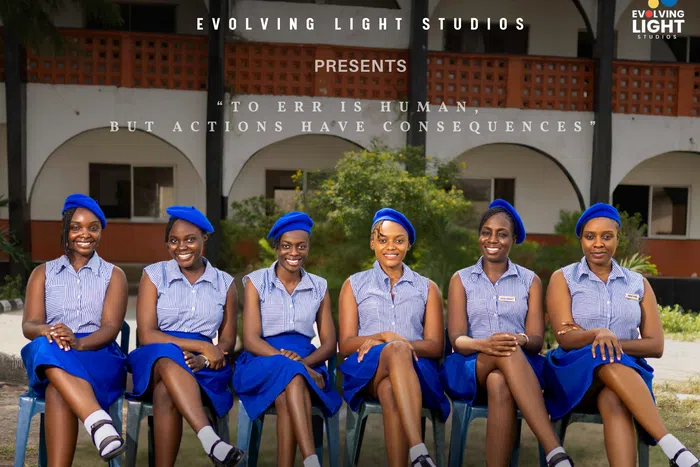

There’s something about secondary school stories that lingers. Maybe it’s the uniforms, maybe it’s the hierarchy, or maybe it’s the quiet yet obvious of trying to belong. Girls’ Hostel leans fully into that world, and not the polished, romanticised version. This one feels closer to memory. A little uncomfortable. A little too real.
Created by Bolu Essien, the series opens with a cloud hanging over its lead character, Ufuoma. She’s not just the “new girl.” She’s a suspect. Two students from her former school are in a coma, and somehow, she’s in the middle of it. Her passport seized. Police involved. Reputation already stained before she even stepped into a new classroom.
That tension travels with her.
And then she meets Lara.
Played within a strong ensemble that includes Bolu Essien, Inem King, Onyinye Odokoro, Darasimi Ogbetah, Ruth ‘Omooba’ Adepoju, Remi Surutu, Toyin Alausa, Eva Ibiam, Miriam Peters and others, the show thrives on character interplay, but Lara is the pulse. The IT girl. The one who has already decided how the social order should look, and refuses to be edited out of it.
)
From the moment Ufuoma arrives, the balance shifts.
A dance battle, simple, almost trivial on the surface, becomes symbolic. Ufuoma wins. Lara loses. And just like that, the throne wobbles.
But Girls’ Hostel isn’t really about dance or debates or school activities. Those are just arenas. The real story is about power. Who holds it, who threatens it, and what people are willing to do to keep it.