

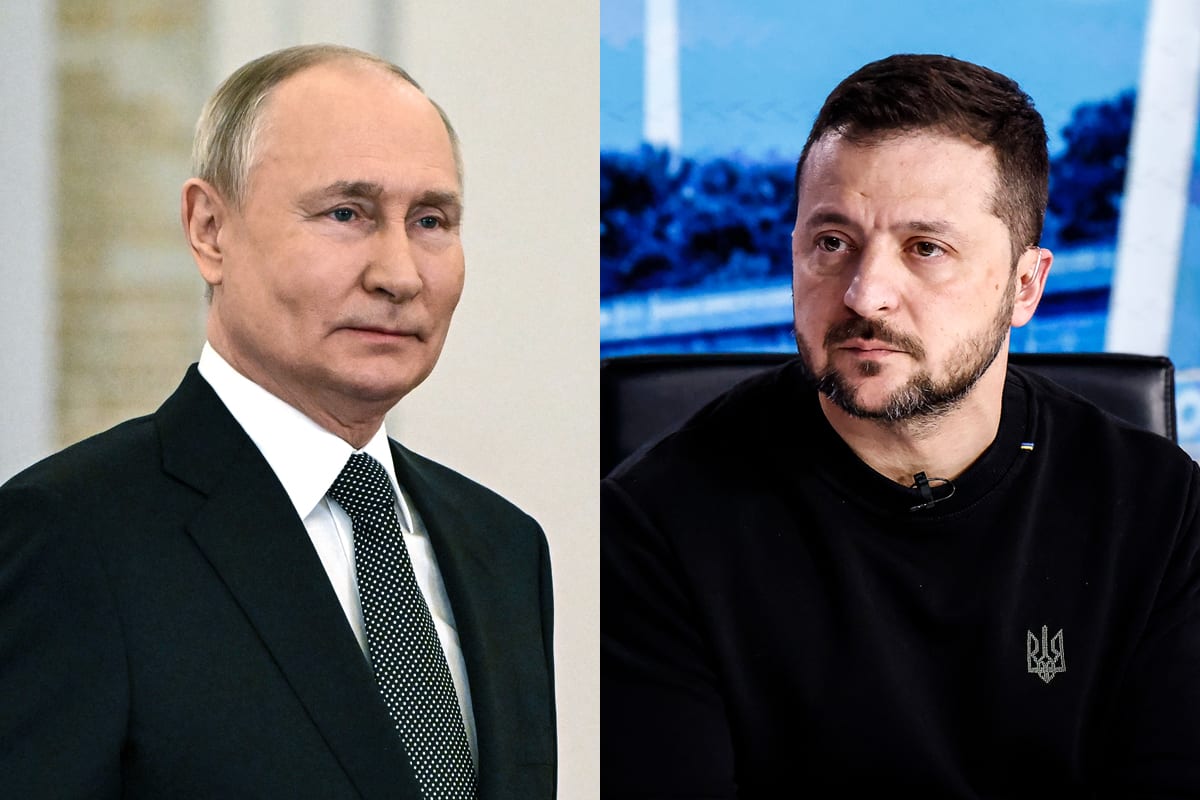

In a new interview with the BBC, Ukrainian President Volodymyr Zelensky declared that Russian leader Vladimir Putin effectively launched World War III when he ordered the full-scale invasion of Ukraine in 2022.
“I believe that Putin has already started it. The question is how much territory he will be able to seize and how to stop him,” Zelensky said in the interview published Monday, on the eve of the fourth anniversary of Russia’s invasion.
He argued that Moscow’s objective goes beyond territorial expansion. According to him, Russia seeks to impose a different way of life on other nations and undermine the choices people have made for themselves.
Zelensky also hardened his tone on Ukraine’s territorial integrity, distancing himself from earlier suggestions that potential land concessions could be considered as part of peace negotiations. He rejected the idea of surrendering roughly 20 percent of the Donetsk region which Russia has sought to fully capture since 2014 along with occupied areas in the Kherson and Zaporizhzhia regions.
He said giving up such territories would amount to abandoning hundreds of thousands of Ukrainians still living there and would weaken the country’s position.
“I don’t look at it simply as land. I see it as abandonment — weakening our positions, abandoning our people,” he said, warning that any withdrawal would divide Ukrainian society.
Although Zelensky had previously floated the idea of allowing Ukrainians to decide on territorial concessions through a referendum, he now insists Kyiv will not cede territory as negotiations stall and proposed Western-backed security guarantees remain unclear.
He also expressed skepticism that concessions would bring lasting peace, suggesting they would only provide Moscow with time to regroup. Zelensky echoed concerns voiced in Europe, including by German officials, that Russia could pose a broader threat to the continent within a few years if it rebuilds its military strength.
Turning to the United States, Zelensky signaled that long-term security guarantees should rely on institutions rather than individual leaders, referencing support from the U.S. Congress rather than placing trust solely in President Donald Trump. He noted that while political leaders change, institutions endure.
Trump had pledged to end the war quickly and has pushed Kyiv toward negotiations that would involve relinquishing parts of the Donbas region. However, no ceasefire has been achieved despite intermittent talks.
On the battlefield, Zelensky struck a defiant tone, rejecting claims that Ukraine is on the verge of defeat. He insisted the country is fighting for its independence and will ultimately restore its territorial integrity, though he acknowledged the heavy human cost of accelerated offensives.
“What is land without people? Honestly, nothing,” he said, emphasizing that any attempt to reclaim territory too quickly could result in devastating casualties.
In a separate interview with Agence France-Presse, Zelensky similarly maintained that Ukraine is “definitely not losing” the war, though he admitted victory remains costly and dependent on sustained international support.
He stressed that Ukraine still needs more weapons and backing from its allies, saying the restoration of Ukraine’s internationally recognized 1991 borders would represent not just victory, but justice.
