

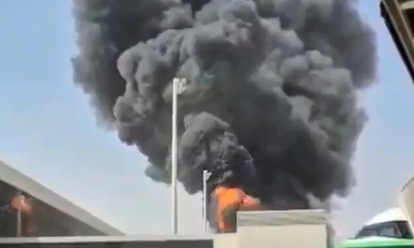

I’m Saudi Arabia’s King Khalid International Airport in Riyadh has suffered a second major attack in two days, with authorities reporting a fire in a passenger terminal and multiple injuries.
A Saudi military spokesman announced on Sunday night, October 11 that a projectile had struck the airport, while the country’s civil aviation authority confirmed that individuals sustained injuries during the incident.
The latest strike follows a devastating attack on Saturday that killed 12 people and wounded more than 300 others. The facility had also come under separate attacks earlier in the week.
Yemen’s Houthi movement claimed responsibility for the renewed wave of assaults, issuing warnings to commercial airlines and passengers to avoid Saudi airports and the country’s airspace.
The group stated that it had deployed ballistic and cruise missiles alongside drones against the airport over a 24-hour period.
The Houthi military spokesman, Brigadier General Yahya Saree, further asserted that oil installations and Dammam Airport in eastern Saudi Arabia had also been targeted.
Saree vowed to sustain what he described as “escalating operations deep inside Saudi Arabia,” warning that aviation hubs across the kingdom remain vulnerable, with the exception of those located in the holy cities of Mecca and Medina.
The Houthis have tied the military escalation to Saudi Arabia’s backing of government forces in Yemen’s civil war, as well as alleged coalition air strikes targeting Sanaa International Airport.
Addressing the latest breach, Major General Turki al-Maliki, spokesperson for the Saudi-led military coalition, stated that air defense systems successfully intercepted a missile near Riyadh’s airport, though teams were simultaneously deployed to extinguish a fire sparked by an “unknown projectile” that hit Passenger Hall No. 4.
International leaders have responded swiftly to the intensifying violence. U.S. President Donald Trump indicated that Washington would “make a decision” on a potential military response against the Houthis and would “move very quickly”.
British Defence Secretary Wes Streeting similarly noted that the UK could “potentially” offer additional defensive assistance to Saudi Arabia.
Saturday’s assault marked one of the deadliest single attacks on Gulf infrastructure since regional hostilities escalated. The Saudi-led coalition condemned the incident as a “war crime” and vowed a firm retaliation.
According to the Saudi General Authority of Civil Aviation, the casualties from Saturday’s strike included four Saudi nationals, two Bangladeshi citizens, and one national each from the United States, Jordan, Palestine, Syria, Sudan, and Egypt. The Indian Embassy in Saudi Arabia also confirmed that an Indian national died from injuries sustained in the attack.
U.S. Secretary of State Marco Rubio condemned the strikes, confirming the death of an American citizen, while British Foreign Secretary Ed Miliband expressed profound outrage. In response, the UK Foreign Office updated its travel guidance, advising against all travel to locations within 10 kilometers of the Yemeni border.
Meanwhile, Houthi-operated Al Masirah television reported that coalition forces carried out a retaliatory airstrike on Sanaa International Airport. Saudi authorities have not officially verified the claim, and independent verification remains pending.
Abdullah Al-Alimi Bawazir, vice-president of Yemen’s internationally recognized government, urged regional and international partners to take “decisive actions” to halt the spiraling violence.
The renewed conflict follows the collapse in July of a temporary ceasefire brokered in 2022, compounding regional tensions after recent territorial shifts along Yemen’s Red Sea coastline.