

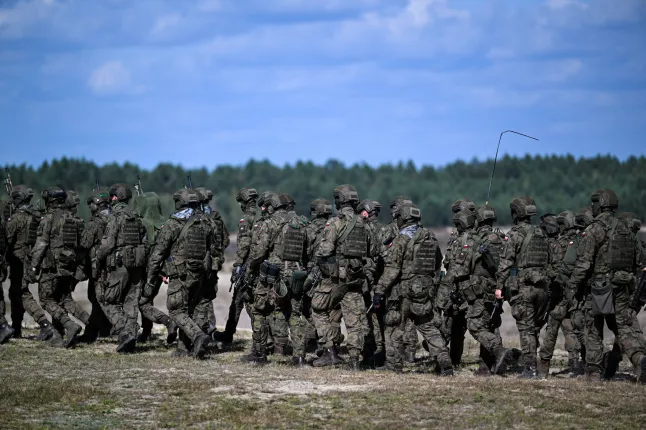

Polish security forces prevented what Prime Minister Donald Tusk described as an attempted Russian “provocation” along the border with Kaliningrad, following reports of individuals approaching with flashlights shortly after midnight.
Tusk said the Border Guard alerted him to movement from the Russian enclave, prompting authorities to deploy additional personnel and resources. “We quickly mobilised the appropriate forces and resources there and managed to prevent any attempted provocation,” he said.
The prime minister said Poland had also received information about possible incidents during the first half of November, including armed incursions into Polish territory. In response, the government decided to reinforce the Border Guard and deploy significant police resources to the area.
Tusk described the coming weeks and months as “critical” for Europe, adding: “We all know and are familiar with this Russian method.” Responding to critics who accuse him of being preoccupied with the threat of a Russian invasion, he defended the government’s approach.
“Yes, I’m obsessed with the threat, which is clearly growing month by month in terms of behaviour toward Poland and Europe, and of course, especially Ukraine,” he said. Separately, Russian attacks on Ukraine prompted airspace restrictions over Poland’s Lublin region. The Polish Government Security Centre issued an alert to residents as air defence readiness was increased.
The developments follow an incident in late September when a Russian Mi-8 helicopter reportedly crossed about 1,000 feet into NATO airspace from Kaliningrad. Polish authorities regarded that incident as a deliberate attempt to test NATO’s defences. It also renewed warnings about civilian preparedness, including the possibility of evacuation during an emergency.
Poland’s deputy prime minister and foreign minister, Radosław Sikorski, previously disclosed that he had prepared an evacuation backpack amid concerns about a wider conflict. Speaking to the newspaper Fakt, Sikorski, 63, urged residents to take official preparedness advice seriously, citing intelligence warnings about the possibility of a Russian attack on a Western country.
“I have stocks of rice, I have a hand pump at home, and I have also made preserves from fruit from my own garden,” he said. “I have the safety instructions, and I have also thought through where the nearest place of shelter is. Everyone should also know how to apply a dressing. That is useful even in peacetime.”
Asked whether residents should prepare bags containing emergency supplies, Sikorski said following government guidance was a sensible precaution. “We have all received the safety instructions, and if the state tells a citizen, ‘Listen, these are unsettled times, it is better to be prepared’, it does no harm to listen to that,” he said. “That is my appeal, to listen to it.”