

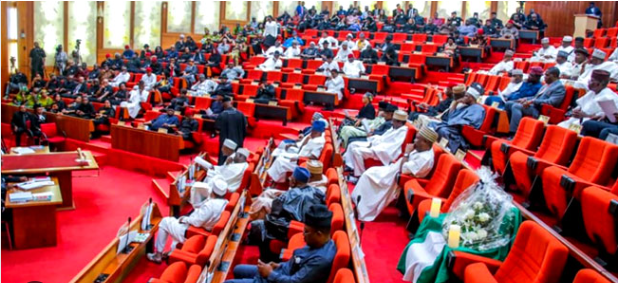

An amendment to the National Social Investment Programme Agency Act (NSIPA) 2023, aimed at moving the agency from the Ministry of Humanitarian Affairs and Poverty Alleviation to the Presidency began yesterday.
Senate Leader Opeyemi Bamidele initiated the Bill seeking to amend the National Social Investment Programme Agency Act, 2023.
Senator Bamidele said the bill seeks to amend Sections 9(3), 14(1), 21(1), 22(1), 26(1) and 33 of the NSIPA Act, 2023 by transferring the agency from the Ministry of Humanitarian Affairs and Poverty Alleviation to the Presidency.
He added that the agency “will now be under the direct supervision of the President.”
The senator further explained its significance to poverty alleviation and social inclusion, saying the plan to amend NSIPA Act, 2023 “is to ensure that the social investment programme are standard, transparent, effective and accountable.”
He explained that the amendment,
“is a result of the commitment of the Renewed Hope mantra of President Bola Tinubu in ensuring that social investment programme are standard, transparent, effective and accountable structure of delivery, adequate coordination and synergy among key government agencies.”
Bamidele (Ekiti Central) noted that the amendment “is in fulfilment of Section 17(3) of the Constitution of the Federal Republic of Nigeria, 1999.”
Under the Section, the state shall direct its policy towards ensuring that all citizens, without discrimination on any group whatsoever, have the opportunity for securing adequate means of livelihood as well as adequate opportunity to secure suitable employment, among others.
He explained that with the amendment, a wide range of Sustainable Development Goals (SDGs), including poverty reduction, education, health, social inclusion and empowerment could be achieved through the NSIPA
Former Senate President, Ahmed Lawan, pointed out that the Ninth Senate passed the bill, though its implementation was flawed because those who should be given support are those difficult to reach in rural areas.
Lawan, (Yobe North), said;
“In achieving social inclusion, funds were distributed, and the beneficiaries have no bank accounts. After passing this, it is time we must participate fully to ensure the capturing of the beneficiaries that need the support in such a way the National Assembly is satisfied.”
He further explained that the National Assembly “should be part of the process, but that was not done. The support was sent to each state of the federation. All senators were onlookers, which is unacceptable.”
In his contribution, Senator Seriake Dickson urged the lawmakers to use the opportunity to look at other issues raised during its implementation under the administration of former President Muhammadu Buhari.
Dickson explained that the amendment should include the mode of selecting the beneficiaries of the programme.
He said the previous government had initiatives like TraderMoni and COVID palliatives without parliamentary approval. Recommendations should also be made at the committee level.
Senate President Godswill Akpabio referred the bill to the committee of the whole for consideration today to allow senators go through the bill clause by clause.
The NSIPA Act was enacted May 2023 to address socio-economic inequalities and alleviate poverty among Nigerians. NSIP was created in 2016 under the administration of former President Muhammadu.
The programme was founded on four pillars, N-POWER Programme; Government Enterprise and Empowerment Programme, National Home-Grown School Feeding Programme and Conditional Cash Transfer Programme.
Each of the pillars was designed to empower the poorest of the poor and most vulnerable Nigerians to attain an acceptable standard of living, irrespective of their locations nationwide.